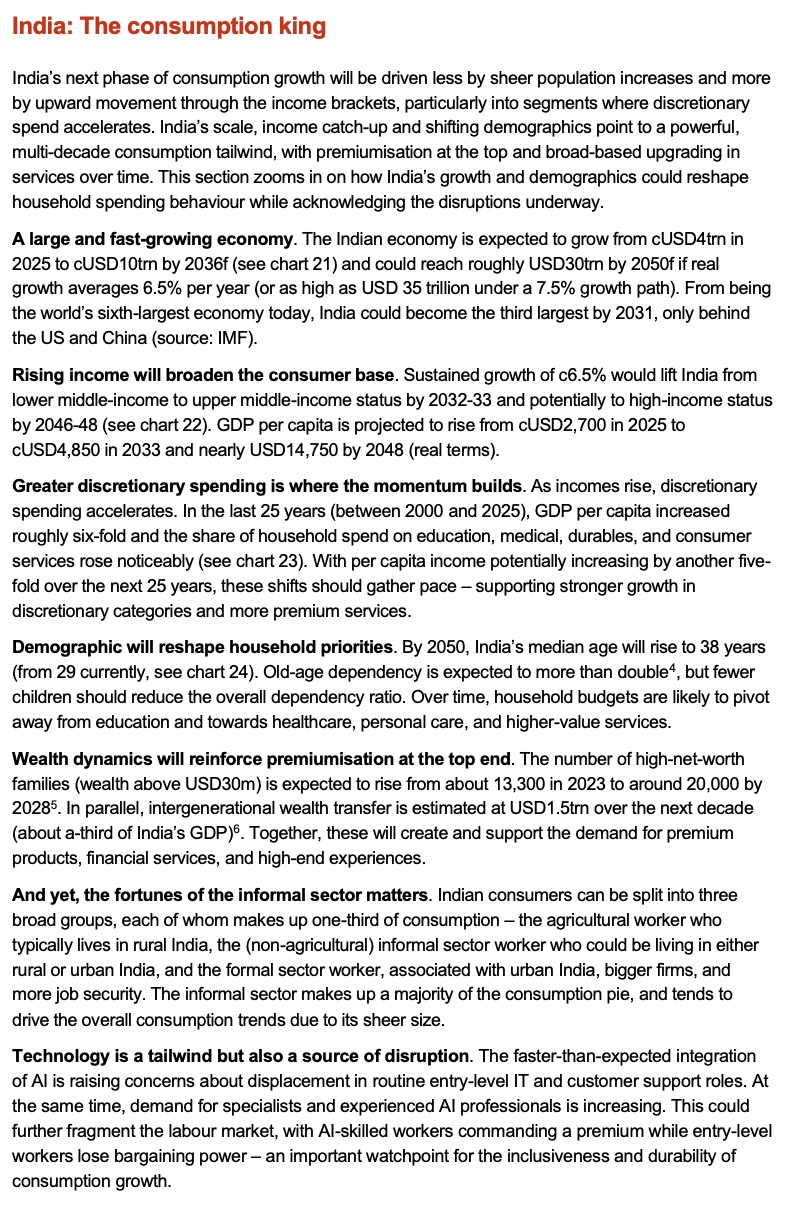
I keep coming back to a research note on India's consumption trajectory that landed in my feed this week. The line that actually matters in it isn't the trillion-dollar economy projection, it's the sentence right before the numbers, that the next phase of growth comes less from more people and more from existing people moving up income brackets. That's a different thesis than the one most consumer decks pitch me, and it changes which ideas I think are actually investable right now.
the ladder itself
India's economy is expected to go from roughly four trillion dollars in 2025 to ten trillion by 2036, and possibly thirty to thirty five trillion by 2050 depending on whether real growth holds nearer 6.5 or 7.5 percent a year. That part isn't the interesting slide, every emerging market deck has a version of it. The interesting line is the per capita number underneath. GDP per capita goes from about 2,700 dollars today to 4,850 by 2033, and toward 14,750 by 2048. India crosses from lower middle income to upper middle income by 2032-33, and potentially to high income by 2046-48. Founders should be building for the household that's about to cross one of those lines, not the household that's already comfortably above or below it. That's a narrower, more specific brief than "India's middle class is growing."
what rises with income
Between 2000 and 2025, GDP per capita rose roughly sixfold, and the share of household spend on education, medical care, durables, and consumer services rose with it. The next 25 years could see per capita income rise another fivefold, and the same categories should accelerate again, discretionary spend specifically, not necessities. This is where I'd point a founder building anything premium, quick commerce, financial products, travel, personal care. The ceiling on willingness to pay is moving up in real time, and a product priced for today's ceiling looks underpriced in three years if it's actually good.
the two-thirds nobody designs for
The note splits Indian consumers into three roughly equal groups, the agricultural worker, the non-agricultural informal sector worker, and the formal sector worker, and together the two informal groups make up a majority of the consumption pie and tend to drive the overall trend because of sheer size. Most consumer software I see pitched is built for the formal, urban, English-comfortable third. That's the smallest of the three by the note's own framing. A founder who designs for vernacular-first, cash-adjacent, low-literacy usage from day one is building for two-thirds of the consumption pie, not carving out a niche. I made a version of this argument in an earlier thesis about consumer apps for Indians, and this note is the macro version of the same point, the distribution and monetization patterns look nothing like a US playbook, but the addressable spend behind them is bigger, not smaller, than the obvious slice.
the wealth concentrating at the top
The number of Indian families with wealth above thirty million dollars is expected to grow from about 13,300 in 2023 to around 20,000 by 2028, and intergenerational wealth transfer over the next decade is estimated at 1.5 trillion dollars, close to a third of India's current GDP. That's a specific, sizeable, underserved segment. Most wealth management and family office tooling I've come across in India is still relationship banking and spreadsheets, not software. A modern layer for the newly wealthy and the inheriting generation is a real, narrow, well-capitalized wedge, not a nice-to-have.
the labor side of the same coin
The same note flags something worth underwriting against, not just building excitement around, AI is displacing routine entry-level IT and customer support roles faster than expected, while demand for AI specialists is rising. That's a labor market that could fragment, a smaller group commanding a premium while a larger group loses bargaining power. If that plays out, it puts real pressure on the durability of the consumption growth this whole thesis leans on. I'm not discounting the thesis because of it, I'm flagging it as the one line in this note I'd want a founder to have an actual point of view on before I fund a bet that assumes broad-based income growth continues uninterrupted.
where I'd actually put checks
None of these are fully formed pitches, they're the ideas that fell out of reading one macro note carefully instead of skimming the headline number. One of them I'd already tweeted out before I connected it to this note.

Pratiksha Dake
@PratikshaDake
Startup idea: family nutrition OS for affluent families. 1. Nutrition officer gets everyone's bloodwork done and creates nutrition plan 2. A kitchen manager gets grocery list based on nutrition plan and list of dishes to be prepared for every meal and cooks them.
- Graduation-ladder financial products. Savings, credit, and insurance built explicitly around the moment a household crosses an income threshold, not a generic product priced the same for everyone.
- Premium quick commerce beyond groceries. Specialty food, beauty, small electronics, riding the same discretionary curve that already built the grocery category.
- Domestic travel and experience booking for tier 2 and 3 cities. Leisure travel stops being a metro-only behavior once per capita income clears the thresholds in the note.
- Home healthcare and elder care platforms. Old-age dependency more than doubling by 2050 is a demand curve with almost no modern software built against it in India yet.
- A family nutrition OS for affluent households. Bloodwork-driven nutrition planning paired with a kitchen manager who turns that plan into an actual grocery list and daily meals, the kind of preventive, higher-value personal care spend this income curve should keep funding.
- Insurance and financial planning products built around a rising median age. A product designed for a 29-year-old median buyer stops fitting a market whose median is 38.
- A modern layer for wealth management and family offices. Thirteen thousand families becoming twenty thousand by 2028 is a specific, countable, underserved buyer.
- Productized concierge services for the mass affluent just below true HNW. The wealth transfer creates an inheriting layer that wants high-touch service at a price point private banking doesn't serve.
- Vernacular-first commerce and fintech infrastructure. Built for the informal and agricultural two-thirds of consumption from the first design decision, not translated down from an English-first product.
- B2B enablement for kirana and informal retail. Letting informal retail participate in premiumisation without forcing a full jump to modern trade.
- Reskilling platforms for entry-level IT and BPO workers. A direct response to the labor fragmentation the note itself flags, not a bet I'd size casually.
- AI copilots that let entry-level workers punch above their band. Framed as keeping a worker relevant and employed, not just efficiency for the employer paying for it.
- Household financial planning tools that actually segment by the three consumer groups the note describes. Agricultural, informal, formal, instead of one averaged product that quietly targets only the formal third.
I'd rather back a founder who read the same note and picked one of these rungs on purpose than one who's building for "India's growing middle class" as an unexamined tailwind. The macro story is real. The list of what to actually build from it is longer, and more specific, than the headline number suggests.
Get new essays and theses by email
More theses
- The GTM insight is the bet now, not the product Sep 25, 2026
- The AI India's mid-market actually needs isn't global Sep 18, 2026
- Where capital efficiency stops being the answer Sep 15, 2026
- The seed bar changes by sector Sep 11, 2026
- A round now needs two burn lines, not one Sep 8, 2026
- AI-native software engineering: the moat moved to verification Aug 31, 2026
- The founder pattern I keep underwriting Aug 15, 2026
- AI agents that act, not just simulate Aug 5, 2026
- AI simulations across use cases Aug 3, 2026
- Quick commerce in India: consumer vs B2B, generic vs vertical Aug 2, 2026
- Consumer applications built in India, for the world Aug 1, 2026
- Consumer applications for Indians Jul 31, 2026
- The CA keeps the relationship, AI does the filing Jul 29, 2026
- Professional services, the wedge is repricing, not rebuilding Jul 22, 2026
- AI from India isn't talent arbitrage relabeled Jul 15, 2026
- Bandwidth beats language for AI in India Jul 5, 2026
- Two AI bets get mistaken for one Jun 30, 2026